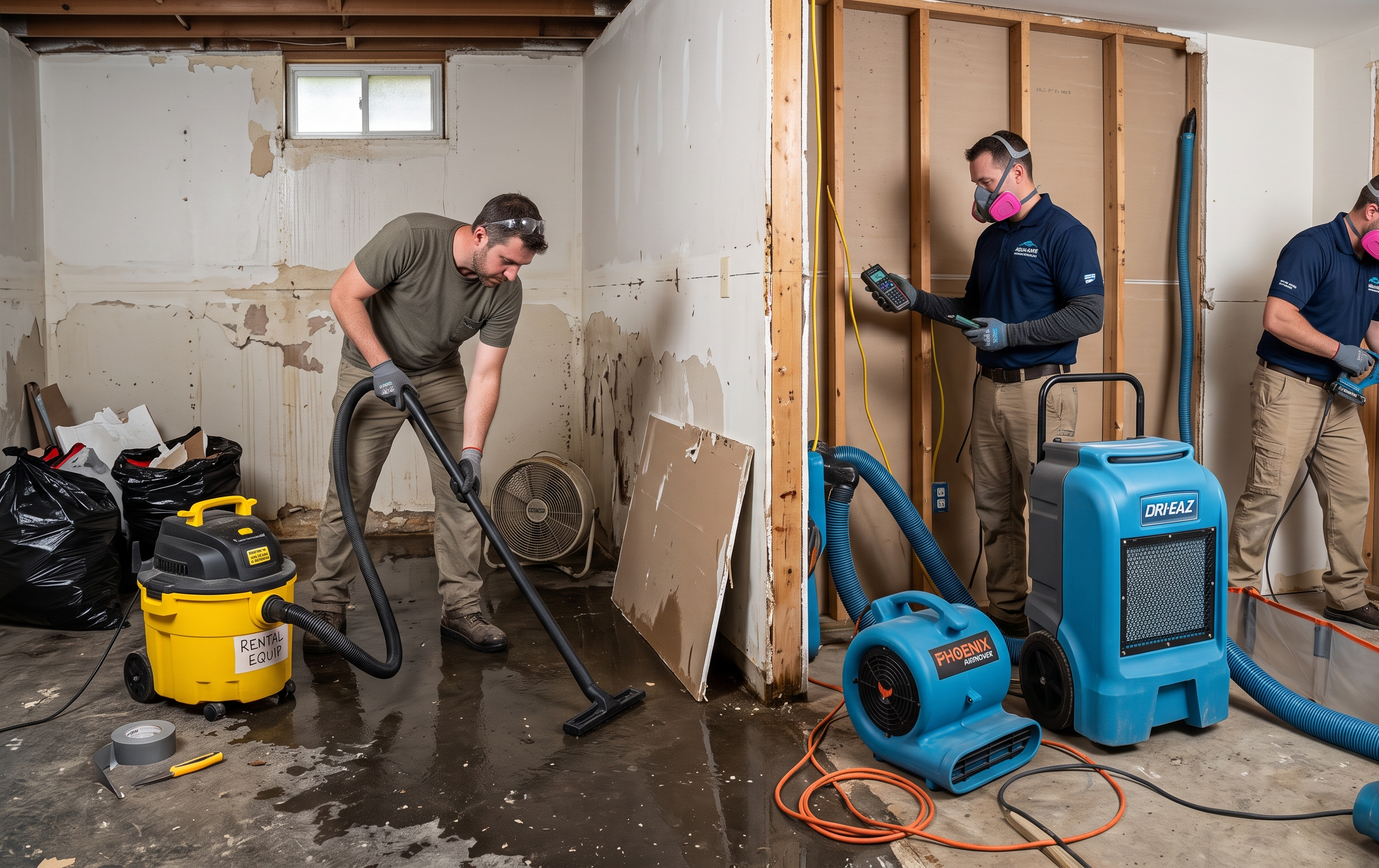
Professional water damage restoration saves more in the long run despite higher upfront costs. DIY may seem cheaper initially but often leads to hidden damage, mold growth, and structural issues that can cost thousands more to fix later.
Based on industry data, homeowners who attempt DIY restoration end up spending an average of 30% more than if they had hired professionals from the start.
How Much Does DIY Water Damage Restoration Actually Cost?
DIY water damage restoration costs typically range from $100 to $1,500 depending on the equipment rented and materials purchased. For small, clean water spills, a simple shop vacuum and rented fans might cost around $50–$150 per day.
But for larger areas, renting industrial-grade dehumidifiers and air movers quickly adds up. Most homeowners end up spending $500 to $1,500 on equipment rental, cleaning supplies, and disposal fees, assuming they only address visible water.
What Are the Hidden Costs of DIY Water Damage Repair?
The real expense of DIY restoration hits later. Without professional moisture detection, water seeps into wall cavities, under flooring, or behind baseboards, causing rot and mold. According to restoration industry experts, 70% of DIY attempts miss hidden moisture, leading to mold remediation costs averaging $2,000 to $6,000.
Structural repairs from incomplete drying can add another $2,000 to $7,500. If mold spreads extensively, costs can exceed $15,000. Many homeowners spend $1,000 on DIY cleanup only to face $5,000 in professional repairs months later.
How Does Professional Water Damage Restoration Cost Compare?
Professional water damage restoration costs an average of $1,384 to $6,384 total, with a national average of $3,867. This includes extraction, drying, sanitation, and monitoring. On a per-square-foot basis, mitigation runs $3 to $7.50 per sq ft, while repairs and rebuilding add $20 to $37 per sq ft.
Professional teams use moisture meters and thermal imaging to ensure complete drying, preventing future issues. While the upfront cost is higher, it eliminates the risk of hidden damage and costly mold remediation.
| Factor | DIY Restoration | Professional Restoration |
|---|---|---|
| Initial Out-of-Pocket Cost | $100 – $1,500 | $1,384 – $6,384 |
| Hidden Damage Risk | High (70% chance of missed moisture) | Low (thermography and moisture meters) |
| Mold Remediation Cost (if needed later) | $2,000 – $6,000 (plus medical bills) | $0 (included in initial mitigation) |
| Structural Repairs (if drying fails) | $2,000 – $7,500 | Covered under single contract |
| Time to Complete | 1–4 weeks (often incomplete) | 3–7 days (certified dry standard) |
| Long-Term Property Value Impact | Negative (mold, rot, warping) | Preserved or improved |
How Quickly Can Mold Grow After DIY Drying?
Mold begins growing within 24 to 48 hours after water exposure. DIY drying often leaves moisture trapped in hidden spaces like insulation, drywall, or subfloors. Without professional equipment, these areas stay damp, creating a perfect breeding ground for mold.
Once mold takes hold, remediation requires specialized removal, containment, and air purification. Health effects include respiratory issues, allergies, asthma attacks, and chronic sinus infections, leading to additional medical costs. Professional restoration teams dry to industry standards (below 15% moisture content), eliminating mold risk.
What Professional Equipment Do Restorers Use That DIYers Don’t?
Professional water damage restoration requires tools that are not available for consumer rental.
These include:
- Industrial-grade dehumidifiers (capable of removing 100+ pints per day).
- High-velocity air movers for targeted drying.
- Moisture meters and thermal imaging cameras to detect hidden water.
- Submersible pumps and truck-mounted extraction units for rapid water removal.
- HEPA air scrubbers to filter mold spores and contaminants.
- Injectidry systems to dry wall cavities and under flooring.
Consumer-grade fans and dehumidifiers lack the power and monitoring capability to ensure complete drying, leading to secondary damage.
When Is DIY Water Damage Drying Appropriate?
DIY water damage drying is only appropriate for Category 1 (clean) water from a broken supply line, affecting a small area (under 100 sq ft) that you can address within one hour. The water must be immediately extracted with a shop vac, then high-powered fans and a dehumidifier should run continuously for 48–72 hours.
Even then, you should monitor moisture levels with a consumer-grade moisture meter. We strongly recommend a professional inspection afterward to confirm complete drying. For any gray or black water (sewage, floodwater), always call professionals due to health risks. If you need help with a burst pipe cleanup or sewage cleanup, don’t take chances.
What Can Go Wrong With Improper Water Damage Dry Out?
Improper drying leads to multiple problems:
- Warped hardwood floors and swollen laminate.
- Delaminated drywall and bubbling paint.
- Rotted wood framing and subflooring.
- Mold growth inside walls (remediation $2,000–$6,000).
- Corrosion of electrical wiring and metal fixtures.
- Odors caused by microbial growth.
- Increased humidity throughout the home, affecting HVAC efficiency.
These issues often surface weeks or months later, requiring expensive repairs that dwarf the initial DIY savings. A professional mold remediation alone can cost as much as the original restoration.
How to Choose Between DIY and Professional Restoration?
Choosing depends on the water category, extent of damage, and your experience. Follow this checklist:
- Water Source: Clean (pipe supply), gray (dishwasher), or black (sewage)? Only clean water is DIY-eligible.
- Area Size: Under 100 sq ft of affected space? DIY may be possible.
- Time Since Leak: Within one hour? If longer, mold risk increases.
- Hidden Moisture Potential: Water has likely seeped under flooring or into walls. Without thermal imaging, you may miss it.
- Drying Equipment: Do you have access to industrial dehumidifiers and proper monitoring tools? Consumer fans are insufficient.
- Time Commitment: Are you prepared to monitor drying for 72+ hours and reassess?
- Health Concerns: Any respiratory issues or mold allergies? Professional drying ensures safe air quality.
If you answer “no” to any of the above, contact a professional. For a free estimate, call (803) 710-6115.
Which Saves More in the Long Run?
Professional water damage restoration always saves more in the long run. While DIY may cost $200–$1,500 upfront, the risk of hidden damage and mold adds $3,000–$15,000+ in future costs. Professional services, averaging $3,867, include thorough drying, monitoring, and a warranty that protects your home’s structure and value.
The peace of mind and health protection alone are worth the investment. Don’t let short-term savings become long-term expenses. If you’re facing water damage, call (803) 710-6115 for immediate professional assistance.